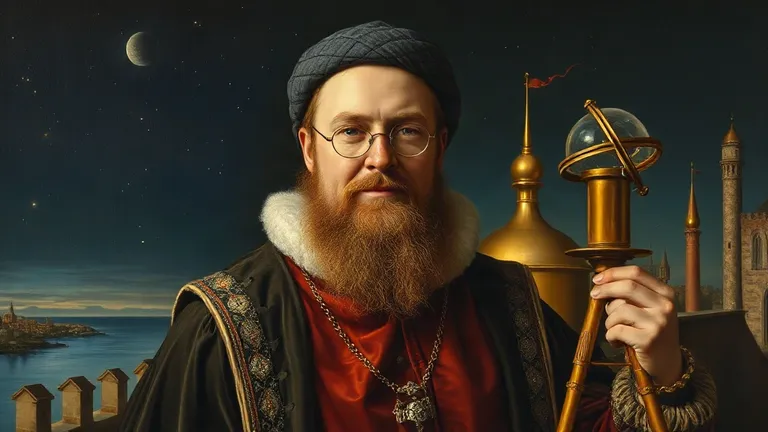
How Geography Shaped Tycho Brahe
Gaze upon a Danish island observatory where a fiery noble mapped the stars without ever using a telescope.
- Stop 1: Herrevad Abbey, Sweden (1572 · Supernova Observation)He observed a brilliant new star in Cassiopeia, proving the celestial heavens were not immutable static spheres.
- Stop 2: Ven (Hven), Denmark (1576 · Uraniborg Citadel)He constructed the ultimate Renaissance astronomical complex, complete with subterranean observatories and private printing presses.
- Stop 3: Rostock, Germany (1597 · Exile Journey)After quarreling with the Danish king, he relocated his elaborate quadrant instruments across the stormy Baltic Sea.
- Stop 4: Prague, Czech Republic (1601 · Imperial Observatory)Serving as Imperial Mathematician, he finalized his planetary tables before passing his vital life work to Kepler.
Geographic Impact: His hyper-accurate celestial measurements laid the empirical foundation for Kepler's laws of planetary motion, fundamentally reshaping terrestrial navigation and cartographic projection methods.