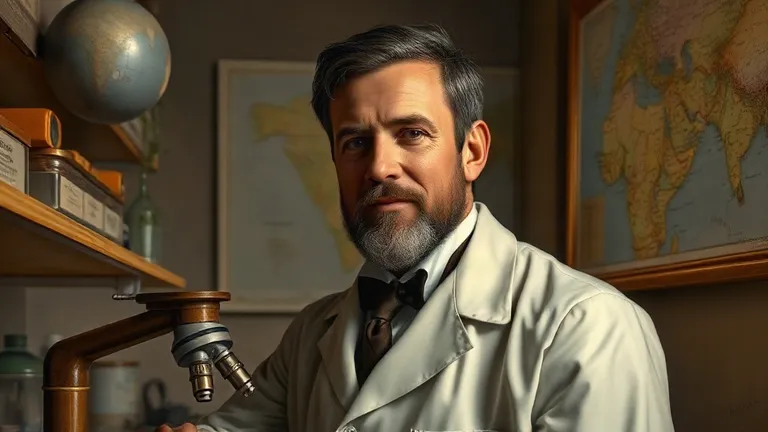
How Geography Shaped Ronald Ross
In the sweltering heat of India, he hunted for the microscopic culprit behind a global health crisis.
- Stop 1: Almora, India (1857 · Birthplace)He was born in the foothills of the Himalayas to a British officer serving in India.
- Stop 2: Secunderabad, India (1897 · Researcher)He made his breakthrough discovery by identifying the malaria parasite in the stomach of a mosquito.
- Stop 3: Stockholm, Sweden (1902 · Nobel laureate)He traveled to Sweden to receive the Nobel Prize for his monumental work in tropical medicine.
- Stop 4: London, England (1932 · Medical expert)He spent his final years working in London to advance the global fight against tropical diseases.
Geographic Impact: His discovery of how malaria is transmitted allowed for the mapping and control of the disease in tropical regions, saving millions of lives and enabling safer global travel and settlement.