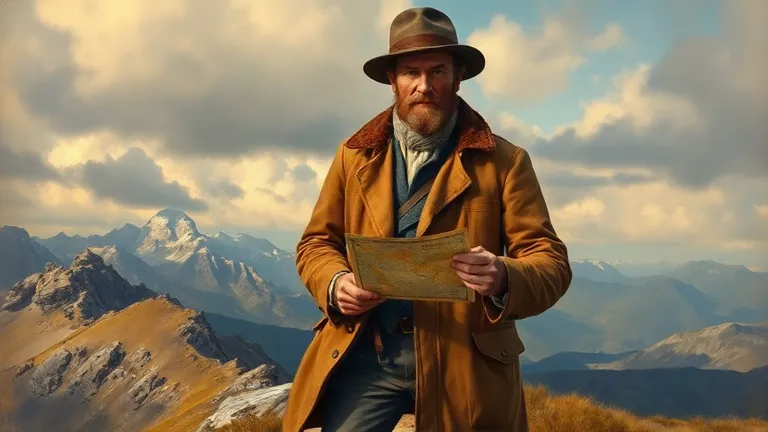
How Geography Shaped Alexander von Humboldt
He climbed the highest peaks and charted the deepest currents to prove that nature is one interconnected machine.
- Stop 1: Cumaná, Venezuela (1799 · Expedition start)He arrived in the Americas to begin his ambitious five-year journey of scientific discovery and botanical collection.
- Stop 2: Chimborazo, Ecuador (1802 · Mountain climber)He ascended this massive volcano, documenting how plant life changes with altitude, a revolutionary concept in science.
- Stop 3: Mexico City, Mexico (1804 · Geographic surveyor)He meticulously surveyed the valley, producing the first accurate maps of the region for European scientific circles.
- Stop 4: Ural Mountains, Russia (1829 · Continental explorer)Invited by the Tsar, he traveled across the vast Russian interior to study the continent's geological structure.
Geographic Impact: His invention of the isotherm and his holistic approach to biogeography fundamentally changed science, proving that climate and vegetation are globally linked, forming the basis for modern environmental geography.